
EX Card Pokémon Explained: Guide for Collectors and Players

EX cards sit at the intersection of competitive power and serious collectible value, yet they trip up even experienced Pokémon TCG fans. The confusion usually starts with capitalization: vintage EX Series cards from 2003 look almost identical to modern ex cards from the Scarlet & Violet era, but the rules, artwork styles, legality, and market prices between the two groups are dramatically different. Whether you’re building a tournament deck, hunting high-grade slabs, or trying to figure out what that old binder card is worth, understanding EX cards from the ground up will sharpen every decision you make at the table and in the trade market.
Table of Contents
- What are Pokémon EX cards?
- How EX card mechanics work in battle
- Name rules, evolution quirks, and deck building
- Collecting, trading, and standard legality explained
- Attacks, abilities, and EX card interaction
- Why mastering EX cards goes beyond the rules
- Upgrade your collection and strategy with PluggedInn.io
- Frequently asked questions
Key Takeaways
| Point | Details |
|---|---|
| Know EX card eras | Vintage EX Series cards and modern ex cards look similar but follow different rules and values. |
| Prize risk and reward | EX cards have powerful attacks but give up extra Prize cards when knocked out in battle. |
| Check legality carefully | Only EX cards with current regulation marks are tournament legal in 2026. |
| Collecting value matters | Some EX cards are collector’s items worth thousands, especially when professionally graded. |
| Watch for unique mechanics | EX cards affect deck building, attacks, and meta strategies in ways regular Pokémon do not. |
What are Pokémon EX cards?
To understand how these cards impact collecting and play, it’s important to first break down what EX cards actually are.
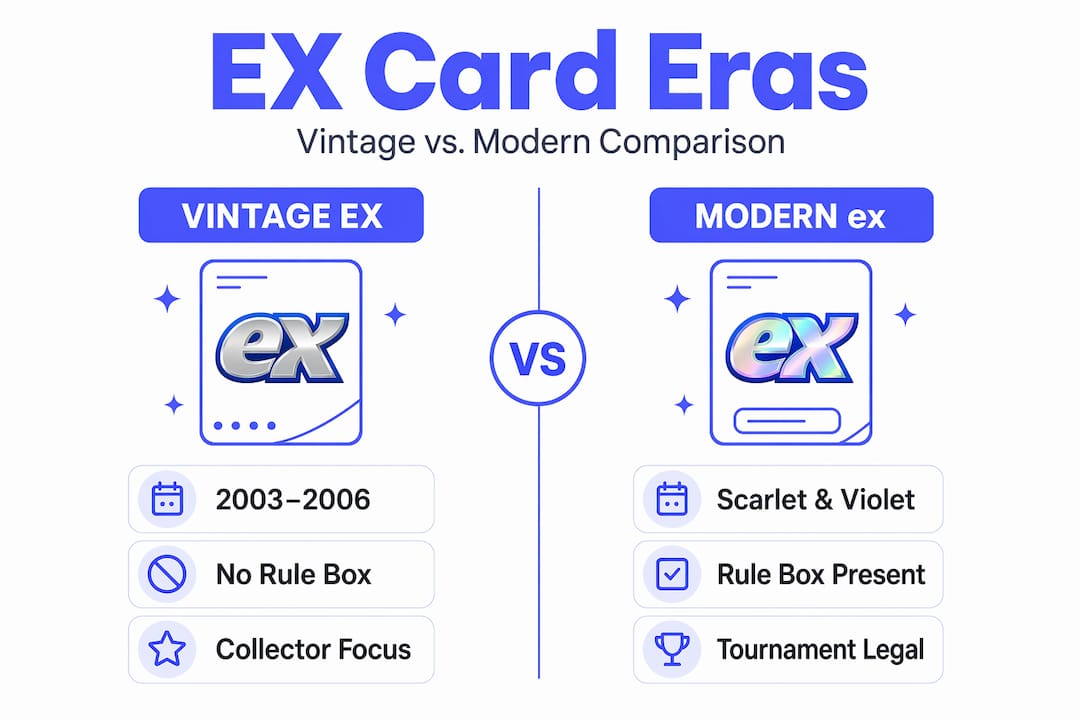
The EX card story spans two distinct eras separated by nearly two decades. Pokémon-ex were introduced) in the EX Ruby & Sapphire expansion in 2003, kicking off what collectors now call the EX Series. That era ran through 2006 and produced some of the most iconic and valuable cards in the hobby’s history. Then, starting with Scarlet & Violet in 2023, The Pokémon Company revived the ex mechanic with updated rules and fresh artwork styles.
Both eras share a core identity: these are powered-up versions of standard Pokémon with higher stats and a significant drawback tied to Prize cards. But the details matter. Modern ex cards) from the Scarlet & Violet Series include a Rule Box printed on the card, while vintage EX Series cards from 2003 to 2006 do not. Effects that reference one era apply to both because they share the same name structure, which creates important deck-building and rules interactions covered later in this guide.
The capitalization difference (EX vs. ex) is not just cosmetic. It signals the era, the rule set, and in many cases, the price range. Treating them as identical cards is one of the most common and costly mistakes collectors and players make.
| Feature | Vintage EX Series (2003–2006) | Modern ex (2023+) |
|---|---|---|
| Rule Box present | No | Yes |
| Standard legal in 2026 | Only if reprinted | Yes (H, I, J marks) |
| Typical market value | High to very high | Moderate to high |
| Mega Evolution available | Yes (M Pokémon-EX) | Yes (Mega Evolution ex, 2025) |
| Art style | Classic painted | Full-art, special illustration |
“The naming convention is intentional. When a card effect says ‘Pokémon-ex,’ it applies to both the vintage EX Series and the modern Scarlet & Violet ex cards. That shared name rule is the bridge between two very different eras.” — Bulbapedia TCG documentation
How EX card mechanics work in battle
Now that you know what EX cards are, let’s see how their mechanics set them apart in actual matches.
The defining mechanic of every EX card is the Prize card penalty. When your opponent knocks out your Pokémon-ex, they take 2 Prize cards) instead of the standard one. In a game where the first player to collect six Prize cards wins, giving up two at once can swing a match instantly. That single rule shapes every strategic decision around EX cards.
In exchange for that risk, EX cards deliver significant power advantages. Pokémon-ex have higher HP), stronger attacks, possible dual Weaknesses and Resistances, and higher retreat costs compared to regular Pokémon. A standard Charizard might sit at 150 HP, while Charizard ex can push 330 HP in the modern format. That durability makes them hard to knock out in a single turn, which partially offsets the Prize penalty.

The 2025 introduction of Mega Evolution Pokémon ex adds another layer. These cards function as Basic, Stage 1, or Stage 2 Pokémon depending on their evolution line, unlike the older M Pokémon-EX cards that had their own MEGA stage and ended your turn when played. The Mega Evolution ex grant 3 Prize cards) on knockout, making them the highest-risk, highest-reward cards in the current format.
Key mechanics every player needs to know:
- Double Prize penalty: Any EX card knocked out gives the opponent 2 Prize cards, not 1.
- Triple Prize for Mega Evolution ex: The newest Mega ex cards push the penalty to 3 Prize cards on knockout.
- Dual Weakness: Many EX cards carry two Weakness types, making them vulnerable to more counter-strategies.
- Higher retreat cost: Most EX cards require 2 to 4 Energy to retreat, limiting your ability to pivot mid-match.
- Stronger attacks: EX attacks frequently hit for 200+ damage or carry effects that standard Pokémon attacks cannot replicate.
- Shared naming: Effects that reference “Pokémon-ex” apply to both vintage and modern ex cards in any legal format.
| Card type | Prize cards on KO | Typical HP range | Retreat cost |
|---|---|---|---|
| Regular Pokémon | 1 | 60–170 | 1–2 Energy |
| Pokémon-ex | 2 | 180–340 | 2–4 Energy |
| Mega Evolution ex | 3 | 300–400+ | 3–5 Energy |
Pro Tip: Build EX-heavy decks around switching cards like Switch, Escape Rope, or Gust of Wind effects. Reducing your opponent’s ability to target your EX cards while maximizing their attack output is the core skill of EX-based deck construction.
Name rules, evolution quirks, and deck building
Understanding the mechanics is one thing, but integrating EX cards into your deck involves a few unusual rules.
The most misunderstood rule in EX deck building involves evolution. Pokémon-ex change the name) in a way that blocks standard evolution. Chansey ex, for example, cannot evolve into Blissey because the card is treated as “Chansey ex,” not simply “Chansey.” That distinction prevents the normal evolution chain from applying unless the card text specifically says otherwise.
This creates a practical deck-building challenge. If you want to run both a regular Blissey line and a Chansey ex in the same deck, you need to plan your card counts carefully. The risk-reward balance) of running both a regular evolution line and an ex line simultaneously is one of the more advanced strategic decisions in the format. Some decks benefit from the redundancy; others get diluted by it.
Step-by-step approach to EX deck building:
- Identify your win condition. Decide whether the EX card is your primary attacker or a secondary threat. That choice determines how many copies you run.
- Check the evolution rule. Confirm whether the EX card blocks a standard evolution you also want to play. If it does, decide whether both lines are worth the deck space.
- Count your Prize exposure. Calculate how many Prize cards your opponent collects if they knock out all your EX cards. If that number reaches 6 too easily, adjust your non-EX support Pokémon count.
- Verify regulation marks. Every card in a Standard tournament deck must carry the correct regulation mark. For 2026, that means H, I, or J marks on every card.
- Test hybrid lines. Some modern reprints of classic EX Pokémon carry current regulation marks, allowing legacy strategies to run in Standard. Always confirm the specific print’s legality before tournament day.
- Build in switching support. High retreat costs on EX cards demand dedicated switching cards. Budget 4 to 6 switching options in any EX-heavy build.
Pro Tip: Always check the card name and regulation mark before finalizing any tournament deck. A card that looks identical to a legal version might be a vintage print without a regulation mark, and that difference gets your deck flagged during a deck check.
Collecting, trading, and standard legality explained
With the intricate mechanics and deck-building quirks covered, it’s just as vital to distinguish which EX cards have collectible or competitive staying power.
From a collector’s perspective, vintage EX Series cards occupy a completely different market tier than modern ex cards. EX Series cards from 2003 to 2006) are considered vintage, and the rarest examples with high PSA grades command extraordinary prices. Gold Star Pikachu, one of the most sought-after pulls from that era, has sold for over $77,000 in PSA 10 condition. That’s not an outlier; several Gold Star cards and secret rare EX cards from that period regularly trade in the thousands.
Modern ex cards are more accessible. Booster packs are widely available at MSRP, and while special illustration rare ex cards do carry premiums, the market ceiling is generally lower than vintage EX Series cards for equivalent grades. That said, certain modern ex cards with unique artwork or short print status are already climbing in value as the Scarlet & Violet era matures.
Key tips for collectors and traders:
- Grade vintage EX cards first. A PSA 9 or 10 on a Gold Star or secret rare EX card multiplies its raw value significantly. Use professional grading services to protect and document your best pulls.
- Distinguish prints carefully. A reprinted ex card with a current regulation mark is not the same collectible as the original vintage print, even if the artwork looks similar.
- Track market trends. Modern ex cards with special illustration art are appreciating faster than standard full-art versions. Monitor recent sales data before trading.
- Understand rotation cycles. Standard format rotation for 2026 requires H, I, or J regulation marks. Cards without these marks are rotated out of competitive play, which can affect their trade value among players.
- Separate play value from collectible value. A card that’s rotated out of Standard can still be extremely valuable as a collectible. Don’t discount vintage EX cards just because they’re not tournament legal.
🏆 Stat callout: Gold Star Pikachu in PSA 10 has sold for over $77,000, making it one of the most valuable Pokémon TCG cards ever graded.
Pro Tip: Always verify both the legality and the current market value of an EX card before completing a trade or submitting it for grading. A quick check of recent sold listings and the regulation mark can save you from undervaluing a card or trading away something tournament-illegal.
Attacks, abilities, and EX card interaction
Legalities and value aside, EX cards also alter how many common attacks and abilities play out during matches.
A significant portion of the modern card pool includes attacks and abilities that specifically reference “Pokémon-ex” as a condition for bonus effects. Many attacks and abilities) target Pokémon-ex for additional damage or specific effects. Grumpig’s Extra Ball, for instance, deals extra damage when the defending Pokémon is a Pokémon-ex. These interactions are not edge cases; they’re core meta considerations.
Notable EX-targeting mechanics in competitive play:
- Damage bonuses: Several attackers deal 60 to 120 additional damage specifically against Pokémon-ex, making them natural counter-picks in the meta.
- Ability shutdowns: Some Pokémon abilities only activate or only affect Pokémon-ex, creating asymmetric disruption that rewards players who know the card pool.
- Item and Trainer interactions: Certain Trainer cards have effects that apply exclusively when your opponent controls a Pokémon-ex, rewarding decks built to exploit that condition.
- Counter-deck archetypes: Entire deck archetypes are built around punishing EX-heavy strategies. These “non-EX” or “single Prize” decks deny the Prize swing that EX decks rely on to win.
“The existence of EX-targeting effects means that running a full EX lineup is never automatically the strongest choice. A well-constructed counter deck can neutralize the power advantage entirely by denying the Prize card economy that EX decks depend on.” — Competitive TCG analysis framework
Understanding which cards in the current format specifically target Pokémon-ex is as important as knowing the EX cards themselves. The meta always responds to dominant strategies, and EX-heavy decks are perennial targets.
Why mastering EX cards goes beyond the rules
Most guides stop at the rules. That’s where the real gaps in player and collector knowledge begin.
The mechanics of EX cards are learnable in an afternoon. But the risk-reward edge cases) that separate average players from strong ones take much longer to internalize. Consider the name-change evolution block. New players read it once and move on. Experienced players build entire deck architectures around it, running both the regular evolution line and the ex line to create flexibility that opponents can’t easily counter.
The same logic applies to collecting. Knowing that Gold Star Pikachu is valuable is common knowledge. Knowing which specific print, which PSA grade threshold, and which market window maximizes your return is the actual skill. Modern reprints of classic EX Pokémon with current regulation marks are a perfect example of an underexploited opportunity. These cards give you access to vintage-era strategies in Standard format, and many collectors and players overlook them entirely because they’re focused on either pure vintage or pure modern product.
The uncomfortable truth about EX cards is that the Prize card penalty is not just a drawback to manage. It’s a design lever that creates the most interesting decisions in the game. When you choose to bench an EX card, you’re making a calculated bet that its power output will outpace the Prize cards it will eventually cost you. Getting that calculation right, consistently, is what separates strong EX players from everyone else.
Upgrade your collection and strategy with PluggedInn.io
If you’re ready to apply these insights and grow as a collector or competitor, these resources will help you get started.
Vintage EX Series cards are among the most rewarding pulls to submit for grading, but only if you use the right process. Plugged Inn’s grading services guide walks you through submission steps, grading tiers, and how to protect your cards before they reach a grading company. Before you trade or sell any EX card, use the card value calculator to benchmark current market prices against recent sales data.

Whether you’re a competitive player building your next Standard deck or a collector hunting high-grade vintage slabs, the Pokémon card guide at Plugged Inn covers everything from regulation mark verification to pack-by-pack pull rates. Stay plugged in, make informed decisions, and never trade blind again.
Frequently asked questions
What’s the difference between EX Series cards and modern ex cards?
EX Series cards are vintage prints from 2003 to 2006 with no Rule Box, while modern ex cards) from the Scarlet & Violet Series (2023+) include the Rule Box and feature updated artwork styles.
Are EX cards legal in tournaments in 2026?
Only EX cards carrying current regulation marks H, I, or J are Standard legal in 2026; older vintage prints without those marks are rotated out unless they’ve been officially reprinted with a current mark.
Why are some EX cards so valuable to collectors?
Vintage EX cards with rare artwork or high professional grades command serious prices; Gold Star Pikachu in PSA 10) has sold for over $77,000, driven by low print runs and intense collector demand.
How can I tell if my EX card is legal for play?
Check the lower-left corner of the card for a regulation mark H, I, or J for 2026 Standard legality; if the card has no regulation mark, it is not currently legal for Standard tournament play.
Do EX cards count as the same Pokémon as regular cards for evolution?
No. Pokémon-ex block standard evolution) because they are treated as a distinct card name, meaning Chansey ex cannot evolve into Blissey unless the card text explicitly allows it.