How to Grade Pokémon Cards With PSA for Max Value

Two identical-looking Pokémon cards can sit side by side and sell for completely different prices — sometimes thousands of dollars apart — based solely on their PSA grade. A raw Charizard might move for $500 while a PSA 10 version of the same card commands $5,000 or more. That gap isn’t luck. It’s the result of understanding PSA’s grading system, preparing cards correctly, and submitting strategically. This guide walks you through every stage of the process so you can stop guessing and start grading with purpose.
Table of Contents
- Understanding the PSA grading scale and its impact
- Preparing your cards for PSA submission
- Step-by-step: How to submit Pokémon cards to PSA
- What to expect: Turnaround times, costs, and resale value
- PSA grading isn’t always the answer: When to look for alternatives
- Speed up and optimize your Pokémon card grading with Plugged Inn
- Frequently asked questions
Key Takeaways
| Point | Details |
|---|---|
| PSA grades drive card value | The PSA grade your card receives is the biggest factor influencing its resale price. |
| Preparation boosts grading results | Careful inspection and cleaning before submission can prevent costly grade drops. |
| Strategic selection saves money | Only submit cards with high PSA 10 potential to maximize your return on investment in 2026. |
| Submission process is precise | Following PSA’s packing and form rules avoids delays and ensures your cards are graded properly. |
| PSA isn’t always best | Sometimes CGC or BGS provide more value, especially for modern cards or bulk grading. |
Understanding the PSA grading scale and its impact
PSA (Professional Sports Authenticator) is the most recognized grading company in the Pokémon TCG market. Before you submit a single card, you need to understand exactly how their scale works and what separates a 10 from a 9.
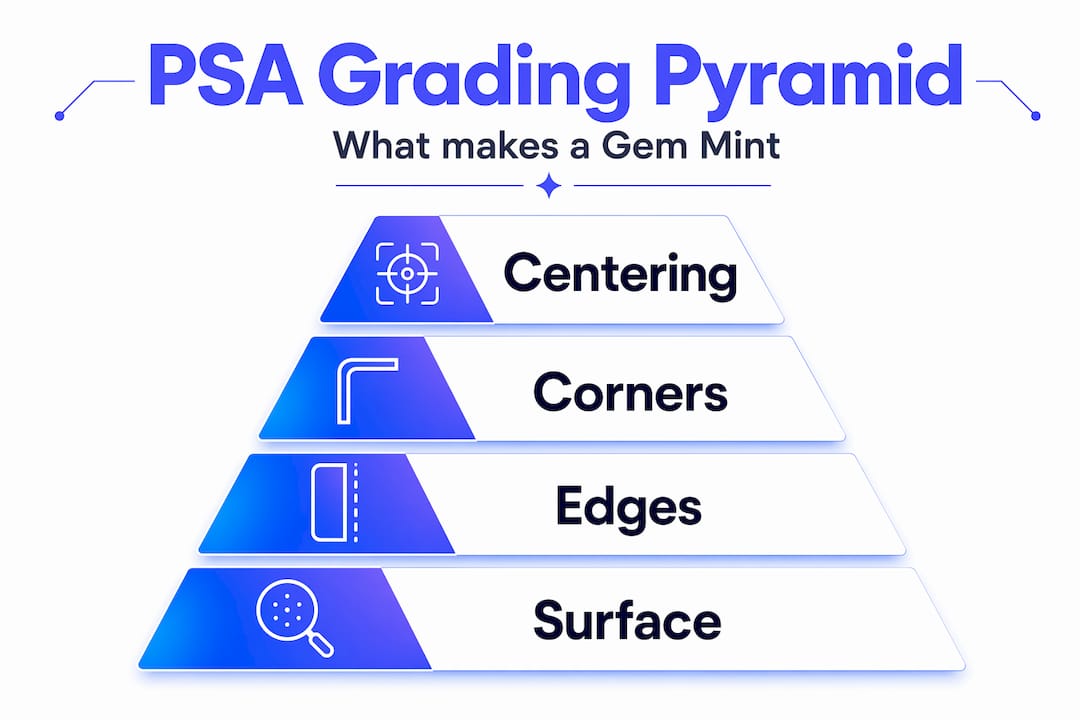
PSA grades Pokémon cards on a 1-10 scale based on four criteria: centering, corners, edges, and surface quality. The overall grade reflects the lowest performing attribute. That last part is critical. You can have a card with perfect corners, clean edges, and a flawless surface — but if the centering is off, the entire grade drops.
Here’s a quick breakdown of the most relevant tiers:
| PSA Grade | Label | What it means |
|---|---|---|
| 10 | Gem Mint | Near perfect in all four criteria |
| 9 | Mint | Minor flaws only; slight off-centering allowed |
| 8 | Near Mint to Mint | Noticeable wear; some whitening or edge chipping |
| 7 | Near Mint | Light play wear visible on multiple attributes |
| 4-6 | Very Good to Excellent | Moderate wear; heavy play use |
| 1-3 | Poor to Good | Significant damage; creases, tears, heavy wear |
For a PSA 10 Gem Mint, front centering must be 60/40 or better, back centering 75/25 or better. Corners must be razor sharp with no whitening. Edges must be clean without chipping. The surface must be flawless with no scratches, print lines, or holo defects even under magnification.
PSA 9 Mint allows minor flaws like slight off-centering (65/35 front), faint print lines, or tiny corner wear. PSA 8 shows more noticeable wear like whitening on corners or edges. The difference between a 9 and a 10 sounds minor on paper, but in practice it can mean a 2x to 5x price difference on the secondary market.
Why population reports matter: PSA tracks how many copies of each card exist at each grade level. This is called the pop report (population report). If 10,000 copies of a modern card have been graded PSA 10, the premium over a raw card shrinks. If only 50 copies exist at PSA 10 for a vintage holo, that scarcity drives serious collector demand.
Pro Tip: Centering issues are the single most common reason cards miss a PSA 10. Before submitting anything, use a ruler or centering tool to measure the borders on both front and back. If the front is tighter than 60/40, save yourself the grading fee.
Preparing your cards for PSA submission
Knowing the scale is step one. Preparing your cards correctly before they ever leave your hands is what actually moves the needle on your results.
Supplies you’ll need:
- Soft penny sleeves (lint-free, brand new)
- Semi-rigid card holders or team bags
- Microfiber cloth (for light surface cleaning)
- Bright LED light or loupe for inspection
- Centering ruler or template
- Bubble mailer or rigid cardboard for shipping
Start your inspection under strong light, tilting the card at multiple angles. Holos are especially vulnerable to hairline scratches that only appear when light hits them at the right angle. Run through each of the four PSA criteria one by one: centering first, then corners, then edges, then surface.
Expert guidance recommends centering as the top killer of grades. Tilt holos specifically to check for scratches. Declare value accurately to avoid upcharges. For volume submissions, use bulk tiers. For cards valued between $500 and $2,500, the Value service tier is the right fit.
When evaluating whether a card is worth grading at all, consider four factors: the card’s current raw value, its rarity and demand, the realistic grade it will receive, and the pop report for that card at PSA 10. A card with a raw value of $30 that realistically grades a PSA 8 is not worth a $24.99 grading fee plus shipping. The math just doesn’t work.
Common flaws and their grading impact:
| Flaw type | Likely grade impact | Notes |
|---|---|---|
| Off-centering (front >60/40) | Drops to PSA 9 or lower | Most common flaw |
| Corner whitening | Drops to PSA 8 or lower | Visible under light |
| Edge chipping | PSA 8 or lower | Check all four edges |
| Surface scratches | PSA 7-9 depending on severity | Holo cards most vulnerable |
| Print lines | PSA 9 at best | Factory defect |
| Holo defects | PSA 9 or lower | Inspect under magnification |
WOTC era cards (Wizards of the Coast, meaning Base Set through Skyridge) present unique challenges. Poor centering is so common in that print era that fewer than 20% of submitted copies can realistically achieve a PSA 10. Holo scratches and print lines are also widespread. Dimples and rough factory cuts are sometimes acceptable if they don’t break into the surface. Front flaws always carry more weight than back flaws in PSA’s evaluation.
Pro Tip: In 2026’s grading market, only submit cards with a realistic shot at PSA 10. With base service fees starting at $24.99 per card plus shipping and insurance, a PSA 9 return on a $40 raw card leaves you underwater. Run the math before you pack the box.
Step-by-step: How to submit Pokémon cards to PSA
Once your cards pass inspection and you’ve decided they’re worth submitting, the actual submission process is straightforward if you follow each step carefully.
Step 1: Create your PSA account. Go to PSAcard.com and register. You’ll need a valid email, billing address, and payment method on file.
Step 2: Select your service level. PSA offers multiple tiers based on declared value per card and desired turnaround speed. Match the tier to your card’s realistic value, not your wishful thinking. Declaring a $50 card at $500 to get faster service triggers upcharges.
Step 3: Enter your card details online. Use PSA’s submission form to enter each card individually. Include the set name, card number, and year. Accuracy here prevents delays during intake.
Step 4: Print your forms and barcodes. PSA generates a packing slip and individual barcodes for each card. Print these clearly. Each card gets its own barcode sleeve placed on the outside of the semi-rigid holder.
Step 5: Pack securely. Stack cards in the order listed on your packing slip. Use bubble wrap or foam padding. Place the packing slip on top. Seal the box firmly. Do not use rubber bands on cards or holders.
Step 6: Ship to PSA. Use a tracked and insured shipping method. The submission process requires the barcode to be visible on the outside of each card’s packaging. Ship to PSA’s current receiving address listed on their site.
Shipping best practices:
- Always insure your package for the full declared value
- Use a rigid outer box, not just a padded envelope, for 10+ cards
- Take photos of your packed cards before sealing the box
- Keep your tracking number until all grades are returned
Pro Tip: Declare value accurately on every submission. Undervaluing a card to save on service tier fees can result in upcharges, delays, or disputes if a card is lost or damaged in transit. PSA’s insurance coverage is tied to your declared value.
What to expect: Turnaround times, costs, and resale value
Grading is an investment with real costs. Understanding the full picture before you submit keeps you from making decisions that hurt your margins.
2026 PSA service tiers:
| Service tier | Cost per card | Estimated turnaround |
|---|---|---|
| Value Bulk | $24.99 | 95 business days |
| Value | $49.99 | 65 business days |
| Regular | $99.99 | 45 business days |
| Express | $149.99 | 20 business days |
| Super Express | $299.99 | 10 business days |
| Walk-Through | $599+ | 7 business days |
As of February 2026, PSA pricing starts at $24.99 per card for Value Bulk with a 95 business day turnaround. Walk-Through service runs $599 or more with a 7 business day window. Importantly, turnaround time starts upon intake, and intake itself adds approximately 15 additional days to the clock.
Your true all-in cost per card includes the grading fee, a portion of your shipping and insurance costs, and any packaging materials. For a 20-card Value Bulk submission, that might look like $24.99 per card in fees plus $2 to $3 per card in shipping and materials, putting your break-even closer to $28 per card before any return.
Factors that influence resale value after grading:
- Grade received: PSA 10 commands the highest premium; PSA 9 still adds value but significantly less
- Pop report: Lower population at PSA 10 means higher collector demand and price
- Card demand: Iconic cards (Charizard, Pikachu, Mewtwo) hold premium regardless of print run
- Market timing: Grading during a bull market in Pokémon TCG maximizes your return
- Set and era: Vintage WOTC cards with low PSA 10 populations carry outsized premiums
PSA 10s boost value by 2x to 10x over raw cards. For rare vintage cards, the gap between a PSA 10 and a PSA 9 can reach tens or even hundreds of thousands of dollars. However, modern cards with high PSA 10 population reports see reduced premiums because supply is abundant.
The practical takeaway: a modern Sword and Shield era card with 15,000 PSA 10 copies in the pop report is not going to 10x in value. A 1999 Base Set Shadowless Charizard with 300 PSA 10 copies is a completely different story.
PSA grading isn’t always the answer: When to look for alternatives
Here’s the perspective most grading guides skip: PSA is not the right move for every card, every collector, or every moment in the market.
PSA dominates Pokémon market liquidity but faces real competition from CGC (faster and cheaper for TCG bulk) and BGS (subgrades for premium cards). The 2026 price hikes make ROI highly selective. Only submitting high-potential PSA 10 candidates makes financial sense at current fee levels.
CGC has been gaining ground in the TCG market specifically because their bulk pricing undercuts PSA for lower-value modern cards. If you’re sitting on a stack of recent set pulls that grade out at $15 to $40 raw, CGC’s lower fees might preserve more margin even if the PSA label carries a slight liquidity premium.
BGS (Beckett Grading Services) remains the preferred choice for collectors who want subgrades, meaning individual scores for centering, corners, edges, and surface printed right on the label. For ultra-premium vintage cards where every fraction of a point matters to a serious buyer, BGS subgrades can actually support a higher sale price.
For investors in the 16 to 45 age range, PSA slabs enhance resale confidence across most platforms. Tracking pop reports to avoid saturated grades is essential post-2026. CGC is gaining TCG market share, but PSA premiums persist for iconic cards.
The uncomfortable truth is that the grading market has matured. The days of submitting any Pokémon card and flipping it for a 5x return are largely over for common modern sets. The collectors and resellers winning in 2026 are the ones who treat grading like a business: calculating costs, researching pop reports, timing submissions around market cycles, and only pulling the trigger when the upside is clear.
Pro Tip: Before submitting, check the PSA pop report and recent eBay sold listings for the card at PSA 10. If the 10 pop is high and recent sales are flat, hold the card raw or explore CGC as a lower-cost alternative.
Speed up and optimize your Pokémon card grading with Plugged Inn
Mastering PSA grading is one piece of the puzzle. The other piece is having the right tools and community around you when it’s time to act.

Plugged Inn gives Pokémon TCG collectors and resellers the resources to make smarter grading and buying decisions. Use our grading investment calculator to run the numbers before you commit to a submission tier. Connect with the Pokémon and TCG Discord community to get real feedback on card condition, pop report strategy, and market timing from collectors who are actively in the game. When you’re ready to move fast on high-demand drops and fast PSA submission opportunities, Plugged Inn’s tools are built to keep you ahead of the market.
Frequently asked questions
How strict is PSA with centering for Pokémon cards?
PSA requires front centering of 60/40 or better for a PSA 10; even minor off-centering that falls outside that threshold will drop your grade to a 9 or lower.
Are older Pokémon cards harder to get graded PSA 10?
Yes, significantly. WOTC-era cards have poor centering and factory flaws so common that fewer than 20% of submitted copies realistically achieve a PSA 10.
How much does PSA grading increase Pokémon card value?
A PSA 10 typically boosts value by 2x to 10x over raw cards, and for rare vintage cards the difference between a PSA 10 and PSA 9 can reach hundreds of thousands of dollars.
What’s the current turnaround time and cost for PSA Pokémon card grading?
Entry-level service costs $24.99 per card with a 95 business day turnaround, while premium Walk-Through service runs $599 or more for a 7 business day window, with intake adding roughly 15 additional days to any tier.